

Yes Car Credit
Vehicle finance from £1,000 to £10,000
However you are looking to finance your next car - we want to make sure you get a YES!
No hard Credit Checks
Only after you have received an offer in full will a hard credit check be done
Secure your funding first - Then find the car
Arrange the car finance, then go find the car to match your budget.
Problem credit? We think we can still help
Struggling elsewhere? Let us have a try - what have you to lose?
Representative APR 16.4%
Car Finance Example (not unsecured borrowing) - Representative example: Amount of credit: £5,000 for 48 months at £139.87 per month. Total amount repayable: £6,713.83. Interest: £1,713.83. Annual interest rate: 15.28% (fixed). Representative 16.4% APR. The rate you're offered depends on your circumstances. Credit broker, not a lender.
Warning: Late repayment can cause you serious money problems. For help, go to moneyhelper.org.uk
Why Choosing Us Makes Sense
Choosing the right car finance provider can be a minefield. Steering clear of hidden finance fees is a challenge in itself — but that's just one example.
Some car finance brokers still place applicants with the lenders that pay them the most commission. While that isn't allowed anymore, there are ways around it — and some brokers only work with a single lender anyway.
That's not how we work. We believe our job is to get you the best deal we can from our wide panel of car finance providers. By looking at how much you want to borrow, your deposit and the other details in your application, we can work out which lender is likely to offer you the cheapest rate.
Interested?
We can arrange for one of our Car Credit finance specialists to talk to you:
Send us an email: carcredit@yesloans.co.uk
We work Monday to Saturday 09:00 - 17:00.

Car Credit Quick Guides
A brief guide to the 3 main different types of car finance in the UK in 2026.
| PCP | Hire Purchase | Car Leasing | |
|---|---|---|---|
| Own the car at the end | |||
| Deposit At The Start | Not always | ||
| Balloon payment at the end | |||
| Possible excess mileage costs | |||
| Affects credit rating | |||
| Credit checks | Soft Checks | Soft Checks | Soft Checks |
| Can hand the car back half way through | |||
| Responsible for wear and tear | |||
| Responsible for major mechanical issues |
Remembering Yes Car Credit of the early 2000s.
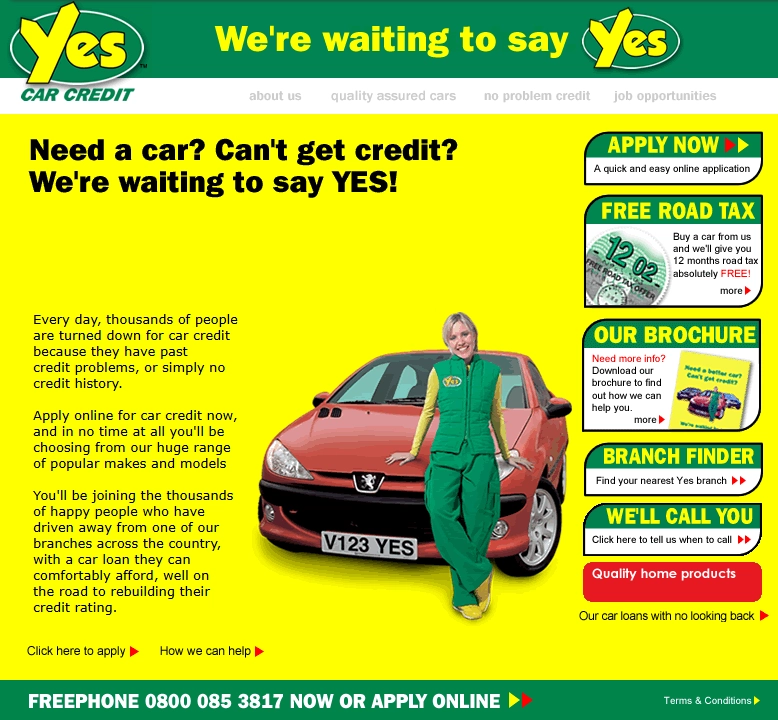
Yes Car Credit: The Rise and Fall of Britain's "We Say Yes" Subprime Car Empire
Not many people will remember it now, but Yes Car Credit was one of the first genuinely national subprime lending brands to appear in the UK. Trading began in 1997 with backing from venture capitalists, and with that investment Yes Car Credit rolled out branches across the country. At its peak it ran 28 branches nationwide - 3 in Scotland, 1 in Northern Ireland, 1 in Wales, and the remaining 23 spread across England. The business was then acquired in 2002 by Provident Financial.
The Brand Starts To Take Criticism
The original Yes Car Credit was often on the receiving end of the usual crowd of media-savvy commentators who made a name for themselves by criticising anyone who turned a profit lending to borrowers other lenders wouldn't touch. People tend to look back at the early 2000s through rose-tinted glasses, imagining credit was easy to come by. It wasn't. Even in 2002, a significant slice of the country simply couldn't get finance to buy a car.
Into that gap stepped Yes Car Credit, running adverts across all the main UK media networks. They hoovered up demand from people who had nowhere else to go.
It wasn't just about the APRs
The problem with the brand wasn't really the cost of the credit. Their APRs at the time were reportedly under 20%, which by today's standards for subprime car finance isn't bad at all. Most of their cars sold for under £4,000, so that worked out at roughly £800 a year in interest - not great, but not outrageous either. By comparison, some bad-credit car finance providers today charge up to 40% APR on an average car price closer to £6,000.
The real issue was that Yes Car Credit wasn't just a finance provider - they were selling their own cars. They ran their own showrooms, kitted out to look every bit as slick as anything Ford or Renault had at the time. That combination is almost unheard of now: the lender and the vehicle retailer being one and the same, rather than the dealer simply introducing you to a third-party finance house. From a regulatory standpoint it's a nightmare, and from a brand-image standpoint it's hard to imagine anything more exposed. At the time the sector answered to the Office of Fair Trading rather than the FCA - but there's little doubt the FCA would be looking hard at a setup like that if it were running today.
The Final Downfall
They became known for selling cars that would barely scrape through an MOT - bald tyres, exhausts hanging off, some buyers reportedly struggling to get the vehicle home at all. The prevailing attitude seemed to be that because these customers couldn't get finance anywhere else, they'd simply have to accept whatever they were given and put up with it. After all, how many of them had the money to take the matter to court? This was well before the mis-selling redress schemes for PPI and payday loans that defined the 2010s. These were some of the most vulnerable customers in the country, and they were being badly treated.
The bigger scandal, though, was insurance. Yes Car Credit - which traded through Direct Auto Finance - was widely reported to make more money from the insurance policies bolted onto each deal than from the car loans themselves. Customers were pushed into expensive payment protection and other add-on cover, often without properly understanding it, and it was this pressure-selling that a subsequent TV investigation exposed. That publicity, more than anything, is what stuck to the brand.
Eventually the bad press became too much for the owners, Provident Financial. The network of showrooms was closed in 2005, with the loss of around 800 jobs.
And while the brand fell dormant in 2005, the company behind it lingered on the books far longer - it wasn't until 2025 that the corporate entity was finally dissolved.